
TL;DR:
- Authentic Latin heritage fashion requires research, collaboration, and understanding cultural significance.
- Modern streetwear reinterpretations should honor, not imitate, traditional elements and political stories.
- Using culturally meaningful colors, materials, and sustainable practices ensures respectful and durable designs.
There is a particular kind of discomfort that hits when you realize your outfit is a costume, not a statement. Generic sombreros on graphic tees, “fiesta” prints with no roots, “spicy Latina” slogans slapped on fast-fashion hoodies — all of it reduces a rich cultural legacy to a punchline. If you want streetwear that actually carries meaning, that feels earned and authentic rather than borrowed and shallow, this guide is for you. We will walk through research, design execution, ethical sourcing, and the mindset shifts that separate genuine heritage fashion from cliché.
Table of Contents
- Start with research and authentic collaboration
- Modernize historic Latin subcultures for streetwear
- Infuse impactful colors, materials, and music influences
- Prioritize sustainability and ethical storytelling
- Avoid clichés, appropriation, and inauthenticity
- A new standard: why true heritage streetwear is more than a trend
- Elevate your style with heritage-infused streetwear
- Frequently asked questions
Key Takeaways
| Point | Details |
|---|---|
| Start with real stories | Authentic Latin-inspired fashion begins with research and collaboration with heritage artisans. |
| Remix subcultures creatively | Modern streetwear thrives when historical Latin narratives are reimagined without stereotypes. |
| Prioritize bold colors and eco materials | Vibrant palettes, natural textiles, and music motifs can honor heritage and make a statement responsibly. |
| Stay ethical and avoid clichés | Give credit, avoid overused symbols, and ensure lasting benefit for source communities. |
| Luxury equals authenticity | Today’s elite streetwear is defined by traceability, real stories, and community impact. |
Start with research and authentic collaboration
Authentic Latin heritage fashion starts long before you pick up a garment. It starts with understanding where a design, textile, or motif comes from and who created it. Skip this step and even the most visually striking piece becomes hollow.
How style reflects heritage is a conversation that goes deeper than aesthetics. Every pattern, weave, and stitch in Latin American textile traditions carries centuries of meaning. Andean weaves communicate cosmology. Otomi embroidery from Hidalgo, Mexico, maps the natural world through vivid flora and fauna. Huipil garments worn by indigenous Maya women encode social status and community identity. Rebozo shawls have represented political resistance and femininity across Mexican history. These are not decorations — they are languages.
The table below gives you a quick overview of prominent Latin American textile traditions and examples of designers honoring them ethically:
| Textile | Region of origin | Key features | Designer example |
|---|---|---|---|
| Andean weaves | Peru, Bolivia, Ecuador | Geometric patterns, natural dyes | Johanna Ortiz |
| Otomi embroidery | Hidalgo, Mexico | Bold floral and animal motifs | Carla Fernández |
| Huipil | Guatemala, Mexico | Hand-woven, community-coded | Isabel Toledo |
| Rebozo | Central Mexico | Fringe, ikat dyeing, silken weaves | Pineda Covalín |
To collaborate directly with indigenous artisans rather than simply copying their work, consider the following practical steps:
- Contact artisan cooperatives through verified organizations like Manos del Uruguay or Chiapas-based weaving collectives.
- Visit craft fairs and cultural markets where artisans sell directly and you can build real relationships.
- Offer fair-trade contracts that include credit attribution and a percentage of profits returned to the source community.
- Document the story behind each textile or motif so it can be shared with the end consumer.
- Avoid mass reproduction of sacred or community-specific designs without explicit consent.
The goal is to research origins, collaborate ethically, and avoid imitation at every stage. Ethical credit-sharing is not optional — it is the baseline for doing this right.
Pro Tip: Attend local Latino cultural festivals, Día de los Muertos events, or mercados in your city. These spaces build genuine relationships faster than any online search.
With a foundation grounded in research and relationship, the next step addresses how to reinterpret and modernize classic Latin aesthetics.
Modernize historic Latin subcultures for streetwear
Latin American style history is full of raw material waiting to be reinterpreted. The key word is reinterpret, not replicate.
The Pachuco movement of 1940s Los Angeles was one of the first instances of Chicano youth using fashion as political resistance. Zoot suits with their wide-shouldered silhouettes and high-waisted trousers were not just clothes — they were a refusal to assimilate. Chicano fashion evolved from there, blending cholo aesthetics, lowrider culture, and Catholic symbolism into a visual language of resilience. Reggaeton brought a different energy: oversized fits, gold chains, and Dominican and Puerto Rican street codes translated into global pop culture. Salsa added structural elegance, with guayaberas and ruffled details that carry diasporic pride.

Designers like Willy Chavarria reinterpret Pachuco zoot suits and Chicano styles into oversized premium streetwear without stripping away political weight. His work is a masterclass in honoring the source.
Here is how old-school subculture staples translate into contemporary streetwear:
| Subculture reference | Classic element | Modern streetwear reinterpretation |
|---|---|---|
| Pachuco/Zoot suit | Wide-leg trousers, long chain | Oversized silhouette, statement hardware |
| Chicano | Cholo script, sacred heart | Graphic back prints, religious iconography |
| Reggaeton | Oversized jersey, gold chains | Drop-shoulder tees, layered chain accessories |
| Salsa/Cumbia | Guayabera, ruffled shirt | Structured button-up layering pieces |
When exploring influential Latin designers for inspiration, use this process to keep your own work grounded:
- Identify a specific subculture or movement — not just a vague region or aesthetic.
- Study the political and social context that shaped the fashion choices of that group.
- Choose one or two signature elements to modernize rather than recreating entire looks.
- Layer narrative detail — a patch, a graphic, an embroidered phrase in Spanish that communicates the story behind the design.
- Test the result with people from that community before releasing it publicly.
Good urban streetwear styling and modern street fashion storytelling share one thing: specificity. Generic “Latin vibes” do not express cultural identity — precise, researched references do.
Pro Tip: Move past surface-level aesthetics. The richest design territory lives in the political narratives: identity, resistance, and belonging. That is where subcultures make fashion immortal.
Once you have chosen meaningful stories and references, the next aspect is executing your design through color, materials, and visual language.
Infuse impactful colors, materials, and music influences
Color in Latin American fashion is never accidental. Every shade carries cultural and emotional weight that predates modern trend cycles.
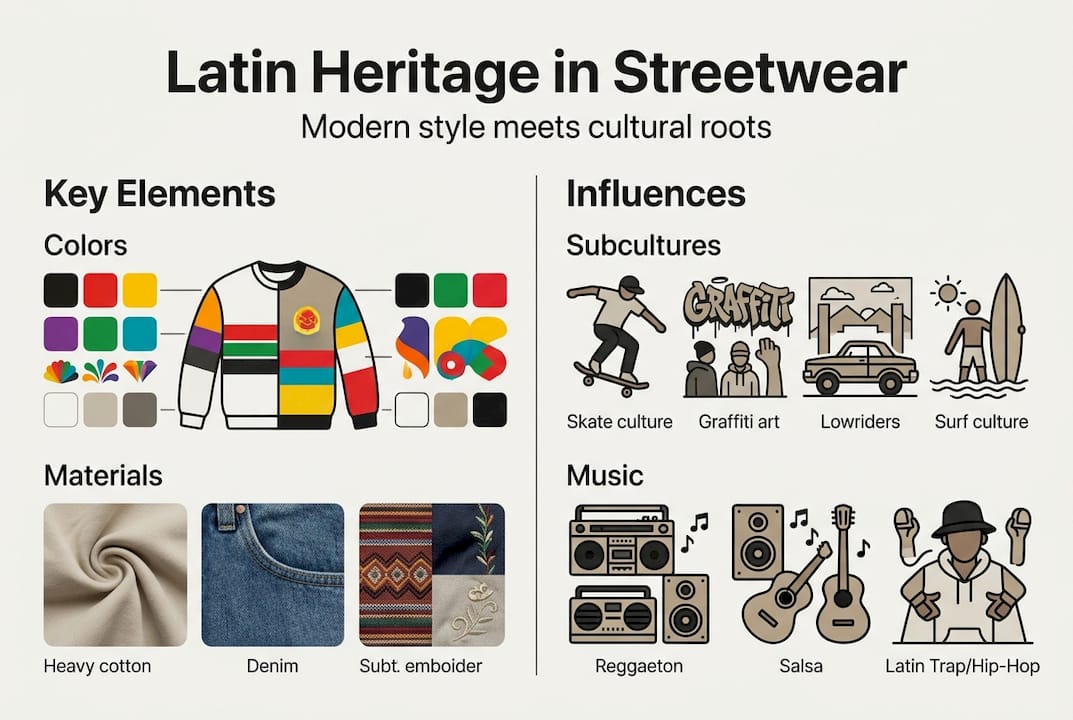
Red signals passion and sacrifice — it appears in everything from Mexican muralism to Caribbean carnival. Yellow represents joy, spiritual energy, and harvest across Andean and Afro-Latin traditions. Turquoise holds deep spiritual significance in Mesoamerican cosmology, used in Aztec and Maya sacred objects long before it became a fashion palette. When you use these colors, you are drawing from systems of meaning. Vibrant color palettes like red, yellow, and turquoise are not decoration — they carry specific cultural weight.
For streetwear and cultural identity to align, your material choices need to match your visual intent. Here are the best natural fibers rooted in Latin American tradition:
- Alpaca wool from the Andes: incredibly soft, temperature-regulating, and durable across seasons.
- Pima cotton from Peru: extra-long staple cotton with superior softness and breathability.
- Andean hand-spun yarn: retains the irregularities that signal handcraft and authenticity.
- Natural-dyed linen: indigo, cochineal, and achiote-dyed fabrics connect to pre-Columbian dye traditions.
Music-driven motifs add another layer of identity. Reggaeton’s visual code: oversized jerseys, platinum chains, and high-gloss accessories. Salsa and cumbia bring structured details — guayabera button patterns, ruffle-edged sleeves, and block-stripe woven trims — that can work beautifully as accent elements on a modern hoodie or jacket.
For a cohesive yet dynamic outfit, apply the 3-3-3 rule: choose three colors, three textures, and three accessories. This keeps Latin-inspired pieces from reading as costume while still delivering visual impact.
Stat to know: Authentic Latin design researchers note that color is one of the primary signals consumers use to code a garment as “culturally inspired” — making intentional palette choices critical to avoiding misread aesthetics.
Pro Tip: Build a digital moodboard before committing to a colorway. Test your palette against reference images of the subculture or region you are drawing from. Clashing or clichéd patterns become obvious fast when laid side by side.
Fabric and visual flair must last — not just look good, but align with today’s responsible fashion values.
Prioritize sustainability and ethical storytelling
Sustainability and heritage are not separate conversations — they are the same one. Cultures that have been weaving with natural fibers and plant dyes for thousands of years were practicing sustainability before the word existed in fashion marketing.
For streetwear brands and style-conscious consumers alike, sustainable practices in heritage fashion include:
- Upcycled textile programs that repurpose deadstock woven fabrics from Latin American mills.
- Made-to-order production that eliminates overstock and reduces waste while increasing perceived exclusivity.
- Partnerships with indigenous women-led cooperatives that keep production local, traceable, and community-funded.
- Organic Pima cotton and alpaca sourced through certified fair-trade supply chains.
- Supra-recycling — transforming end-of-life garments into new pieces without degrading fiber quality.
“The future of luxury fashion is not exclusivity through price alone. It is exclusivity through traceability — knowing exactly who made your garment, from what material, in what community.”
Traceable production is also a powerful storytelling tool. When a hoodie’s label tells you the name of the cooperative that wove its trim, or links to a video of the artisan behind the embroidery, the garment becomes something you cannot find in a fast-fashion store. That is premium. That is what the sustainable streetwear guide we believe in actually looks like in practice.
Pairing with basics extends the life of heritage pieces too. Fewer, better garments — chosen intentionally and styled repeatedly — is the approach that sustainable weaving for heritage advocates argue for most consistently.
With the how-to framework in place, it is time to address common mistakes and pitfalls that can undermine authentic Latin heritage in fashion.
Avoid clichés, appropriation, and inauthenticity
Even well-intentioned designers fall into traps that reduce Latin culture to shorthand. Knowing the red flags gives you the tools to course correct.
Here are the top clichés to cut immediately:
- Taco and jalapeño motifs used as humor or decoration without cultural context.
- Generic sombrero graphics applied to garments with no connection to Mexican regional identity.
- “Spicy Latina” or “caliente” slogans that reduce identity to a single sexualized stereotype.
- Day of the Dead skull aesthetics copied without engaging the Oaxacan or Aztec traditions behind them.
- Pan-Latin homogenization — treating Mexico, Colombia, Peru, and Cuba as interchangeable visual sources.
To research origins, collaborate ethically, and avoid imitation is the consistent recommendation from cultural designers across the spectrum. And even diaspora designers risk appropriation if they are not actively sharing profits and credit with the source communities their work draws from. Having Latin roots does not automatically make a design ethical — the relationship with the community still has to be built.
“Harm does not always look intentional. If you discover a design has crossed a line, acknowledge it publicly, pull the product, and redirect revenue to the affected community. Silence compounds the damage.”
For expressing authentic identity through fashion, the check is simple: can you name the specific community, region, or movement behind every design element? If the answer is no, keep researching before you release.
A new standard: why true heritage streetwear is more than a trend
Here is what most streetwear commentary gets wrong: it frames Latin heritage fashion as a seasonal mood, something that peaks when a major artist drops an album or a global brand decides the aesthetic is “in.” That framing misses everything that actually makes this space powerful.
The best heritage-driven pieces do not chase trends. They build artifacts. A hoodie that references Pachuco resistance culture or Andean cosmology carries weight that outlasts any trend cycle because the story behind it is real and irreplaceable. Meaningful style reflection is what separates a garment people wear once from a piece they keep for a decade.
Luxury today means traceability and community impact, not just high price points. The most respected brands in this space share one trait: accountability. They know exactly where every material came from and who benefits when a product sells. That is the standard worth chasing — not hype, not novelty, not borrowed “exoticism.” Cultural roots, worn with respect and depth, are a permanent advantage over anything fast fashion can produce.
Elevate your style with heritage-infused streetwear
If this guide has shifted how you think about Latin heritage in fashion, the next move is finding pieces that already embody these principles. At Klepsa, every garment in the Codex I collection is built around narrative first — clean front profiles, bold high-definition back graphics, and heavy-duty fleece construction that lasts.

The Insula Hoodie and the Mentis Labor Hoodie are both examples of what happens when Latin-inspired cartography and philosophical storytelling meet premium garment quality. No clichés. No fast-fashion shortcuts. Just streetwear designed to be worn and remembered. Discover more at Klepsa and find the piece that carries your story forward.
Frequently asked questions
What are the most important materials for Latin heritage fashion?
Key materials include Andean weaves, Otomi embroidery, huipil, rebozo, alpaca wool, and Pima cotton, each sourced directly from Latin American artisan communities for maximum authenticity and cultural integrity.
Is it possible to blend Latin heritage and sustainability in fashion?
Yes — upcycling, made-to-order production, and organic Pima cotton or alpaca fibers let you honor heritage and care for the planet at the same time.
How can I avoid cultural appropriation when using Latin motifs?
Always credit original communities, collaborate ethically, and share profits or visibility with artisans. The rule is clear: research, collaborate, avoid imitation before any design goes public.
What fashion trends are inspired by Latin American music?
Reggaeton brings oversized jerseys and chain accessories to streetwear, while salsa and cumbia inspire guayaberas and ruffle details that translate beautifully into structured layering pieces.
What is the 3-3-3 rule in Latin-inspired streetwear?
The 3-3-3 rule means building an outfit with three colors, three textures, and three accessories for a dynamic, balanced look that avoids visual chaos.