
TL;DR:
- Over 60% of streetwear buyers under 25 prioritize brand heritage for authenticity.
- Heritage-driven streetwear emphasizes cultural motifs, artisanal techniques, and meaningful storytelling.
- Minimalist design amplifies heritage’s impact, fostering authenticity, community, and economic empowerment.
More than 60% of streetwear consumers under 25 rank brand heritage as a top reason they buy. That’s not a small signal. It means the culture has shifted away from chasing logos and limited drops toward something with actual roots. Heritage in streetwear isn’t decoration—it’s the whole foundation. This article breaks down how cultural heritage drives authenticity, shapes minimalist design, and gives your wardrobe a meaning that fast fashion simply can’t fake. If you’ve ever felt like a piece of clothing should say something deeper about who you are, you’re already thinking about heritage, even if you didn’t have the word for it.
Table of Contents
- Why heritage matters in streetwear today
- How heritage influences design: motifs, techniques, and materials
- Brand case studies: Heritage-driven minimalist streetwear
- Culture, resistance, and economic power: The wider impact
- A fresh take: What most people miss about heritage in streetwear
- Explore premium minimalist streetwear inspired by heritage
- Frequently asked questions
Key Takeaways
| Point | Details |
|---|---|
| Heritage builds authenticity | Genuine storytelling drives credibility and identity in minimalist streetwear. |
| Motifs convey culture | Patterns and artisanal methods bring history and meaning to modern style. |
| Subtlety equals power | Understated heritage details can be far more impactful than loud designs. |
| Support real stories | Choose brands that meaningfully connect with their roots to foster sustainable fashion. |
Why heritage matters in streetwear today
Streetwear started as a language. Skaters, hip-hop artists, and immigrant communities used clothing to communicate where they came from when the mainstream didn’t represent them. That original impulse never disappeared. What changed is the scale. Today, how heritage shapes style is one of the most discussed questions in the culture, because young consumers have gotten tired of empty branding.
Heritage acts as authenticity and storytelling currency. When a brand can point to a real cultural tradition, a geographic identity, or an artisanal method with actual history, it creates credibility that no marketing budget can manufacture. Authenticity and cultural storytelling in streetwear aren’t just buzzwords—they’re the core of what separates a meaningful piece from a blank hoodie with a price tag.
Fast fashion operates in the opposite direction. It scans trends and replicates surface aesthetics without any real connection to their origin. You get the look but not the meaning. For young urban adults who want their clothing to reflect identity, that gap feels enormous. The absence of a story is itself a statement, and it’s not one most people want to make.
Here’s what drives heritage demand right now:
- Cultural pride: Younger generations are actively reclaiming identities their parents were pressured to downplay.
- Credibility signals: Heritage is how you know a brand actually stands for something.
- Resistance to commodification: Heritage-rooted pieces push back against the idea that style is interchangeable.
- Community belonging: Wearing heritage means being part of a living narrative, not just a consumer demographic.
“Heritage is the creative currency of modern streetwear—the difference between a brand that looks cool and one that actually means something.”
The streetwear market growth in recent years isn’t driven by hype alone. It’s driven by people who want their clothes to hold weight. When you understand that, heritage stops being a niche interest and starts being the most important design brief in the game.
With heritage’s demand established, let’s see how it actually appears in leading streetwear pieces.
How heritage influences design: motifs, techniques, and materials
Heritage doesn’t show up in streetwear by accident. Designers make deliberate choices to embed cultural memory into the physical object. The most powerful examples use three distinct tools: motifs, artisanal techniques, and material choices.
Cultural heritage motifs and artisanal techniques promote identity reclamation and sustainability in ways that mass production simply cannot replicate. African wax print textiles, First Nations geometric patterns, and Korean hanbok-derived silhouettes have all made their way into contemporary streetwear because designers from those communities are finally getting platforms.
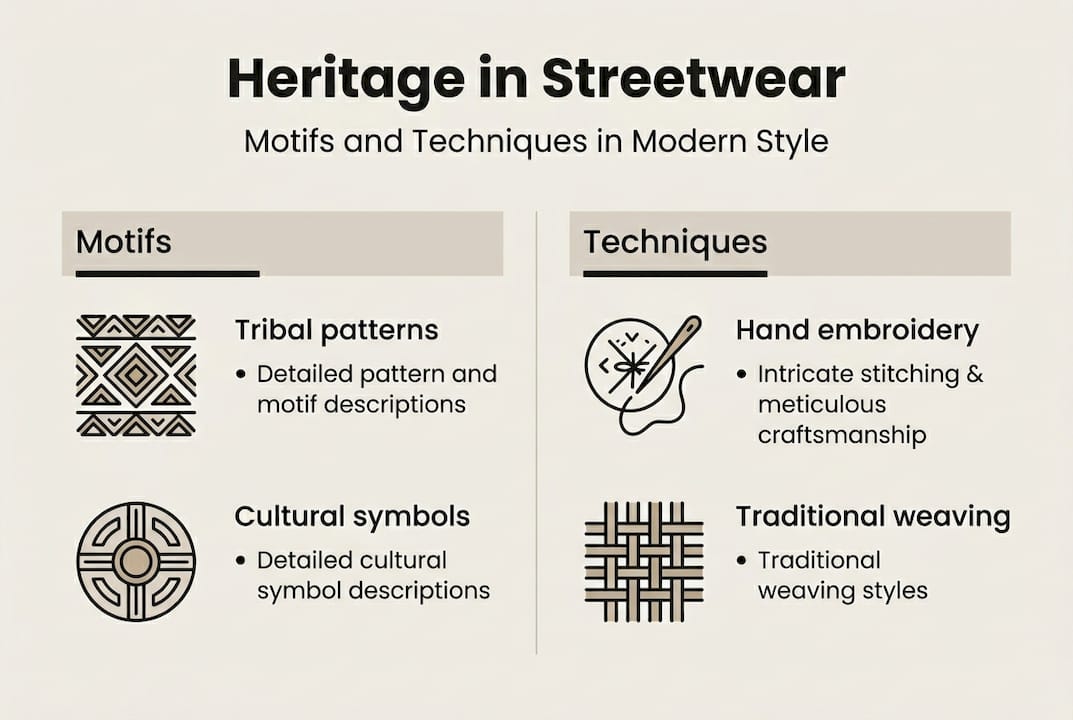
Here’s how heritage elements actually break down across different design approaches:
| Heritage source | Key motif or technique | Streetwear application |
|---|---|---|
| West African textiles | Kente weave patterns, bold color blocking | Graphic panels, printed fleece |
| First Nations design | Geometric symbolism, natural dye methods | Embroidered patches, tonal blocking |
| Latin cartography | Historical maps, typographic reference | Back graphic storytelling, DTG print |
Artisanal methods create a quality gap that becomes immediately obvious when you hold the garment. Hand-stitched embroidery, natural dye processes, and high-definition direct-to-garment printing all take more time and skill than factory stamping. That investment shows in the final piece, and it’s something buyers can feel.

Sustainability is an underrated benefit here. Heritage craft methods tend to use local materials, smaller production runs, and techniques that generate less waste. That’s a direct contrast to fast fashion’s overproduction model. Minimalist craft and storytelling often come hand in hand precisely because restraint in design usually reflects restraint in production.
Here’s how to read a heritage piece when you encounter one:
- Look for the specific cultural reference in the design brief or brand story.
- Check if the technique matches the tradition it claims to honor.
- Ask whether the brand involves makers from the relevant community.
- Assess whether the motif is placed with intention or just used as filler pattern.
Pro Tip: If a brand can’t tell you where a motif comes from or what it means, that’s a red flag. Genuine sustainable streetwear is always backed by a traceable story.
Understanding these design cues, let’s explore how iconic streetwear brands leverage heritage for market impact.
Brand case studies: Heritage-driven minimalist streetwear
Nothing makes an abstract concept real faster than seeing it executed by actual brands. The most interesting examples aren’t the loudest ones. They’re the brands that use restraint to let the cultural reference breathe.
Off-White bridges heritage luxury and streetwear through Virgil Abloh’s now-legendary “3% rule.” The idea is that changing just 3% of an existing design creates something entirely new while honoring the original. Abloh applied this to luxury heritage references, classic workwear, and fine art. The result was streetwear that felt historically grounded without being a museum piece.
| Approach | Minimalist heritage brand | Maximalist heritage brand |
|---|---|---|
| Design language | Clean silhouettes, back narrative | Heavy print, all-over pattern |
| Cultural signal | Subtle reference, requires context | Immediate visual recognition |
| Audience | Informed, curious buyers | Broad trend followers |
| Longevity | High, narrative deepens over time | Lower, trend-dependent |
The minimalist approach wins on longevity because the story can evolve. A clean front with a meaningful back graphic, for example, rewards the person who takes time to look and understand. That kind of design respects the audience’s intelligence.
Steps that serious brands use to honor heritage in modern silhouettes:
- Research the origin culture directly, not through secondhand references.
- Collaborate with designers or makers who have personal connections to that heritage.
- Document the story and share it as part of the product’s identity.
- Keep the design language consistent across the collection so the narrative builds.
Pro Tip: Elevating minimalist streetwear isn’t about stripping everything away. It’s about choosing what to keep so that every element carries weight. Heritage only works in minimalism when the reference is specific enough to mean something.
Copying a traditional motif without context is the fastest way to produce something inauthentic. Brands that express identity with streetwear successfully treat the cultural reference as the starting point for a conversation, not a surface to decorate.
Brands prove the influence, but how does heritage in streetwear impact culture, economy, and resistance?
Culture, resistance, and economic power: The wider impact
Heritage streetwear has always been political, even when it doesn’t look like it. Wearing your culture’s visual language in a mainstream space is an act of presence. It says: we’re here, this is ours, and it’s not going anywhere.
Heritage enables cultural resistance and economic empowerment, particularly for First Nations designers and other underrepresented communities who have watched their aesthetics get borrowed without credit for decades. Building brands rooted in that heritage redirects economic value back to the source. That’s a structural shift, not just a style choice.
Political streetwear faces real pushback in anti-DEI climates. Brands that center cultural identity can find themselves navigating institutional resistance while still speaking directly to communities that feel their identity is under pressure. That tension makes the work more urgent, not less.
But over-commercialization is a genuine threat. When a heritage motif goes viral, fast fashion moves fast. Suddenly the same pattern appears on ten thousand units from a factory that has no connection to its origin. Over-commercialization of heritage can dilute authenticity and contribute to what industry observers call a “streetwear recession,” where oversaturation kills the credibility that made the original pieces valuable.
How to support authentic heritage-driven brands:
- Buy directly from brands that clearly document their cultural references.
- Research the founding story before you purchase.
- Prioritize brands that reinvest in communities connected to their heritage.
- Avoid platforms that aggregate trend-adjacent designs without cultural context.
“When heritage acts as creative currency, the wealth stays within the culture that created it. The moment it gets extracted without attribution, the currency devalues.”
This is also where meaning and hype in streetwear diverge most sharply. Hype is temporary. Meaning compounds. The brands that build on genuine heritage create something that gets more valuable the longer you hold it, because the story keeps deepening.
A fresh take: What most people miss about heritage in streetwear
Here’s a perspective most think pieces skip entirely: minimalist streetwear is not heritage-neutral. The restraint itself communicates something. When a brand strips away every unnecessary element and still leaves a specific cultural reference in place, that reference becomes the whole statement. Minimalism doesn’t dilute heritage. It amplifies it.
The loudest heritage pieces often miss the mark for this reason. When every surface is covered in cultural imagery, the individual elements lose their weight. It starts to look like a costume rather than a conviction. Subtlety requires more confidence, not less.
What really separates a powerful heritage piece from a decorative one is the buyer’s relationship to the story. You don’t have to share the exact cultural background of the designer to connect with the narrative. But you do need to know it. Wearing a piece you’ve researched and chosen deliberately, one that reflects something real about how you see yourself, is more empowering than wearing a trend. That’s the idea behind quiet luxury streetwear: the statement is internal first, visible second.
Explore premium minimalist streetwear inspired by heritage
If this article shifted how you think about what your clothing should communicate, the next step is finding pieces that actually deliver on that. Not everything labeled streetwear is built with a real story behind it.

At Klepsa, every piece in the Codex I collection is designed around a specific narrative drawn from Latin heritage, cartography, and the philosophy of time. The Insula Hoodie and Tempus Hoodie are built on heavy-duty 3-end fleece with high-definition DTG back graphics that make the story visible without shouting it. Clean fronts, loud meaning. Explore the full Klepsa streetwear collection and find the piece that speaks to your narrative.
Frequently asked questions
What does heritage mean in streetwear?
Heritage in streetwear refers to drawing inspiration from cultural practices, motifs, or artisanal techniques to create authentic pieces that tell a story rather than simply follow a trend.
Why do young people value heritage in streetwear?
Over 60% of under-25 consumers see heritage as a defining factor for credibility, identity, and originality, making it one of the strongest purchase drivers in the category.
How can I tell if streetwear is genuinely heritage-inspired?
Look for authentic artisanal techniques and cultural motifs with documented stories behind them. Decorative patterns without context are a clear sign the heritage connection is surface-level only.
Does heritage streetwear help promote sustainability?
Yes. Heritage designs typically rely on artisanal skills and local materials, which supports cultural preservation and produces far less waste than conventional mass-production methods.